Pages

Showing posts with label Laws. Show all posts

Thursday, June 27, 2013

New York Senate Ends Session with out actin on Marijuana Bills

ALBANY, NY — Senators in the New York Legislature adjourned for the 2013 session without voting on a medical marijuana bill or addressing a bill that would have fixed loopholes in the state’s decades-old marijuana decriminalization law that allows police to arrest people for having marijuana in “public view.”

Assembly Bill 6716 and its identical companion Senate Bill 3105, would have decriminalized possessing up to 15 grams of marijuana in public view, while smoking in public would remain a misdemeanor. Under the state’s 1977 marijuana decriminalization law, private possession of up to 25 grams of marijuana is a non-criminal citation, punishable by a $100 fine. However, the possession of any amount of marijuana in “public view” has and will remain a criminal misdemeanor.

Assembly Bill 6357, the Compassionate Care Act, which would have allowed the medical use of marijuana by qualified patients in New York. This is the fourth time that the New York Assembly has passed medical marijuana legislation.

Monday, May 6, 2013

Ohio Lawmaker Introduces Measure to Put Marijuana Legalization Before State Voters

Via: NORML
Representative Robert F. Hagan (D-Youngstown) has introduced a measure that would put marijuana legalization on the ballot before state voters. House Joint Resolution 6 would place a question on the Ohio ballot asking voters to approve allowing people 21 or older to purchase and use marijuana. Under this proposal marijuana would be sold only by state-licensed establishments and would be subject to a 15 percent excise tax.

“With billions upon billions spent on the war on drugs with little progress to show for it, it is time for more-sensible drug policy in this country,” stated Representative Hagan.

To be placed on the ballot, HJR 6 would need to receive a three-fifths vote from the legislature. The full text of the measure is available online here.

If you live in Ohio, please take a moment to contact your Representative and urge him/her to support this historic legislation! It is time to let the people of Ohio decide for themselves whether or not it is time to legalize marijuana.

Wednesday, April 17, 2013

Vermont House Approves Marijuana Decriminalization

Valley News
If this bill goes all the way Vermont would become the 16th state to have decriminalized.
The Vermont House gave preliminary approval Friday to a bill that would change the offense of possessing up to an ounce of marijuana from a misdemeanor crime to a civil offense similar to a speeding violation.

On roll call vote of 98-44, the House endorsed the bill, which would impose a fine of as much as $300 for anyone caught with up to an ounce of the drug.

The bill also contains provisions designed to eliminate the possibility of a permanent criminal record or future collateral consequences such as ineligibility for certain jobs or government benefits for those convicted of possessing up to two ounces, or up to four plants.

The legislation now goes to the Senate, which is also expected to pass it.

Sunday, April 7, 2013

Kentucky Industrial Hemp Legislation Becomes Law Without Governor’s Signature

On Friday, April 5th, Governor Steve Beshear of Kentucky let Kentucky’s industrial hemp measure become law without his signature. Gov. Beshear had expressed concerns that marijuana growers could hide their illegal growing operations with hemp plants. Despite his concerns, he allowed the measure to become law without his signature and did not veto the legislation.

After the bills approval by the state legislature, Kentucky Agriculture Commissioner James Comer stated that “by passing this bill, the General Assembly has signaled that Kentucky is serious about restoring industrial hemp production to the commonwealth and doing it in the right way. That will give Kentucky’s congressional delegation more leverage when they seek a federal waiver allowing Kentucky farmers to grow hemp.”

Kentucky is now the ninth state to have passed a law allowing for farmers to cultivate industrial hemp. Hemp cultivation is still prohibited by the federal government.

Saturday, March 30, 2013

Marijuana Legalization Measure Formally Introduced in Maine

Representative Diane Russell (D-Portland) formally introduced LD 1229: An Act to Tax and Regulate Marijuana into the Maine legislature. This legislation would legalize the sale of as much as 2 1/2 ounces of marijuana per week to people 21 or older at licensed retail locations. It would also permit for the cultivation of the plant in private settings. The measure has been assigned to the Joint Standing Committee on Criminal Justice and Public Safety, but has yet to be scheduled for a hearing.

Saturday, March 23, 2013

House Resolution 499: Ending Federal Marijuana Prohibition Act of 2013

HR 499

House Resolution 499 introduced by Congressman Jared Polis (D-CO) has proposed legislation, which would effectively end the federal prohibition on marijuana and allow states to set their own policies.
House Resolution 499: The Ending Marijuana Prohibition Act of 2013, would remove marijuana from the Controlled Substances Act, transfer the Drug Enforcement Administration’s authority to regulate marijuana to a newly renamed Bureau of Alcohol, Tobacco, Marijuana and Firearms, require commercial marijuana producers to purchase a permit, and ensure that federal law distinguishes between individuals who grow marijuana for personal use and those involved in commercial sale and distribution.
NORML Take Action to End Marijuana Prohibition! Congress needs to hear from you, please take a minute and click here to quickly and easily write your Representative and urge him or her to support the Ending Federal Marijuana Prohibition Act of 2013!

Tuesday, October 30, 2012

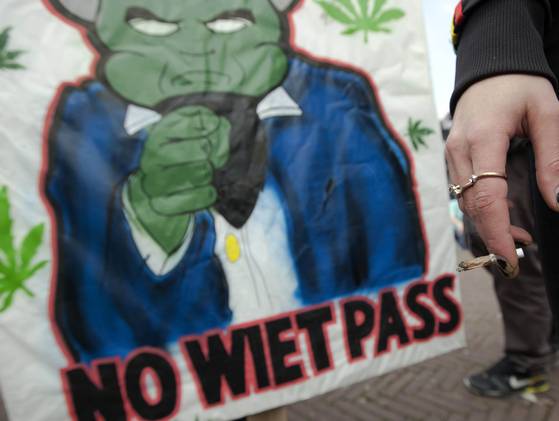
Incoming Dutch government ditches 'weed pass' plan

USAToday

The incoming Dutch government has ditched plans for a national "weed pass" that would have been available only to residents and that would have effectively banned tourists from Amsterdam's marijuana cafes.

However, under a provisional governing pact unveiled this week, cities can bar foreigners from weed shops if they choose.

The pact says that it wants only Dutch residents to have access to marijuana cafes, but leaves enforcement up to cities. Amsterdam opposes a ban, which would hurt tourism.

Some cafe owners said Tuesday that they are satisfied Dutch weed policy will remain unchanged, while others criticized the lack of clarity.

Marijuana trafficking is technically illegal in the Netherlands, but people can't be prosecuted for possession of small amounts and the drug is sold openly in designated "coffee shops."

Friday, May 4, 2012

Nancy Pelosi condemns raids on medical marijuana

Pelosi.House.gov

May 2, 2012
San Francisco – Democratic Leader Nancy Pelosi released the following statement today in response to recent federal government actions threatening safe access to medicinal marijuana for those who are seriously ill or enduring difficult and painful therapies:

“Access to medicinal marijuana for individuals who are ill or enduring difficult and painful therapies is both a medical and a states’ rights issue. Sixteen states, including our home state of California, and the District of Columbia have adopted medicinal marijuana laws – most by a vote of the people.

“I have strong concerns about the recent actions by the federal government that threaten the safe access of medicinal marijuana to alleviate the suffering of patients in California, and undermine a policy that has been in place under which the federal government did not pursue individuals whose actions complied with state laws providing for medicinal marijuana.

“Proven medicinal uses of marijuana include improving the quality of life for patients with cancer, HIV/AIDS, multiple sclerosis, and other severe medical conditions.

“I am pleased to join organizations that support legal access to medicinal marijuana, including the American Nurses Association, the Lymphoma Foundation of America, and the AIDS Action Council.

“Medicinal marijuana alleviates some of the most debilitating symptoms of AIDS, including pain, wasting, and nausea. The opportunity to ease the suffering of people who are seriously ill or enduring difficult and painful therapies is an opportunity we must not ignore.

“For these reasons, I have long supported efforts in Congress to advocate federal policies that recognize the scientific evidence and clinical research demonstrating the medical benefits of medicinal marijuana, that respects the wishes of the states in providing relief to ill individuals, and that prevents the federal government from acting to harm the safe access of medicinal marijuana provided under state law. I will continue to strongly support those efforts."

Friday, January 13, 2012

DEA Admits THC is Medicine

If the Feds Get Their Way, Big Pharma Could Sell Pot -- But Your Dime Bag Would Still Send You to Jail | Drugs | AlterNet

The DEA initially made public its desire to recognize the use of marijuana plant-derived pharmaceuticals in a "notice of proposed rulemaking," which appeared in the November 1, 2010 edition of the Federal Register.


The agency posted, "This proposed rule is issued by the Deputy Administrator of the Drug Enforcement Administration (DEA) to modify the listing of the Marinol formulation in schedule III so that certain generic drug products are also included in that listing." (Marinol is the brand name for dronabinol, a prescription pill approved by the FDA in the mid-'80s that consists of synthetic THC in sesame oil and is encapsulated in a soft gelatin capsule.)

Wednesday, January 11, 2012

Florida Medical Marijuana Bills Filed

Florida Medical Marijuana Bills Filed | The Daily Chronic

For the second year in a row, medical marijuana legislation has been filed in Florida, and for the first time ever, bills have been filed in both the House and the Senate. The bills, House Joint Resolution 353 and Senate Joint Resolution 1028, ask the legislature to approve a referendum on medical marijuana for the November ballot.

If the legislature approves the resolutions, the referendum must then win the approval of 60% of the voters. If 60% of the voters approve it, the state constitution would be amended to include medical marijuana language.

Under the resolutions, patients with a doctor’s recommendation and his or her primary caregiver would have an affirmative defense if charged with a marijuana offense as long as the amount of marijuana was not greater than the amount set by the state and could still mount an affirmative defense if it was, provided that greater amount is “medically necessary.” The amount is not set in the resolutions; instead, the legislature would be charged with setting quantity limits in the event the referendum passes.

Monday, November 14, 2011

Missouri Secretary of State: News Release

Two Initiative Petitions Approved for Circulation for 2012 Ballot

– Secretary of State Robin Carnahan today announced that two initiative petitions relating to cannabis have met state standards for circulation.
The ballot title for the first petition relating to cannabis reads:
Shall the Missouri Constitution be amended to:
  • legalize cannabis (commonly known as marijuana) for individuals 21 years or older;
  • make medical cannabis available to individuals with a physician’s recommendation including those under 21 with parental or legal guardian consent and physician supervision;
  • create licensing processes for operation of cannabis establishments;
  • release individuals incarcerated or on probation or parole for non-violent, cannabis-only offenses which would no longer be illegal and expunge all records related to such offenses; and
  • allow the legislature to enact a tax on the retail sale of dried cannabis up to $100 per pound?
Annual state government operating costs would increase by at least $1 million with the total increase being unknown. Those costs would be offset by an unknown increase in fee and tax revenues. The fiscal impact to local governmental entities is unknown with some increase in revenue possible.
The petition, which would amend Article IV of the Missouri Constitution, was submitted by Mr. Dan Viets, 15 North 10th Street, Columbia, MO 65201.
The ballot title for the second petition relating to cannabis reads:
Shall Missouri law be amended to:
  • legalize cannabis (commonly known as marijuana) for individuals 21 years or older;
  • make medical cannabis available to individuals with a physician’s recommendation including those under 21 with parental or legal guardian consent and physician supervision;
  • create licensing processes for operation of cannabis establishments;
  • release individuals incarcerated or on probation or parole for non-violent, cannabis-only offenses which would no longer be illegal and expunge all records related to such offenses; and
  • allow the legislature to enact a tax on the retail sale of dried cannabis up to $100 per pound?
Annual state government operating costs would increase by at least $1 million with the total increase being unknown. Those costs would be offset by an unknown increase in fee and tax revenues. The fiscal impact to local governmental entities is unknown with some increase in revenue possible.
The petition, which would amend Chapters 105, 195 and 263 of the Missouri Revised Statutes, was also submitted by Mr. Dan Viets, 15 North 10th Street, Columbia, MO 65201.

Before any constitutional changes can be brought before Missouri voters in the November 2012 election, signatures must be obtained from registered voters equal to eight (8) percent of the total votes cast in the 2008 governor's election from six of the state's nine congressional districts. For statutory changes, signatures must be obtained from registered voters equal to five (5) percent of the total votes cast in the 2008 governor's election from six of the state's nine congressional districts.

Signatures on behalf of all initiative petitions for the 2012 ballot are due to the Secretary of State’s office by no later than 5 p.m. on May 6, 2012.

Before circulating petitions, state law requires that groups must first have the form of their petition approved by the Secretary of State and Attorney General. The Secretary of State then prepares a summary statement of no more than 100 words and the State Auditor prepares a fiscal impact statement, both of which are subject to the approval of the Attorney General. When both statements are approved, they become the official ballot title.

Saturday, June 18, 2011

New York Marijuana Laws

I'm going to be posting US state laws mostly so there is no misconception of what is legal an what isn't. However it is not these laws are not to be used as the basis of any illegal action. Just because X amount of grams won't get jail time doesn't mean you should be careless.

As a New Yorker this had to be my first post on state laws. So lets begin.
Is there a Medical Program? No
Is it Decriminalized? Yes
Possession of 25 grams or less (first offense) is a civil citation punishable by a fine of $100, no criminal charge.

Possession of less than 25 grams, second offense, is also not a crime, and carries a fine of $200.

Possession of less than 25 grams, third offense, is a misdemeanor, punishable by 5 days in jail and/or a $250 fine.

Possession of 25 grams to 2 oz is a misdemeanor, punishable by 3 months and a $500 fine.

Possession of 2 to 8 oz is a class A misdemeanor, punishable by 1 year in jail and/or a $1,000 fine.

Possession of 8 to 16 oz (first felony) is a class E felony, punishable by 1-4 years in prison and a $5,000 fine. If it is the second offense, the jail time is 3-4 years with a mandatory ½ time jail sentence.

Possession of 1 to 10lbs (first felony) is a class D felony, punishable by 1-15 years in prison and/or a $5,000 fine. If it is the second offense, it is mandatory to serve at least ½ of the sentence.

Possession of more than 10lbs (first felony) is a class C felony, punishable by 1-15 years in prison and/or a $5,000 fine. If it is the second offense, it is mandatory to serve at least ½ of the sentence.

The distribution or cultivation of 2 oz or less with no compensation is a class B misdemeanor, and is punishable by 3 months in jail and/or a $500 fine.

The distribution or cultivation of 25 grams or less for compensation is a class A misdemeanor, and is punishable by 1 year in jail and/or a $1,000 fine.

The distribution or cultivation of 25 grams to 4 oz (first felony) is a class E felony, punishable by 1-4 years in prison, and a $5,000 fine. If it is the second felony, there is a 3-4 year prison sentence, with a mandatory ½ time served.

The distribution or cultivation of 4 to 16 oz (first felony) is a class D felony, punishable by 1-7 years in prison and a $5,000 fine. You can get probation if you have no prior felony on your record.

The distribution or cultivation of 1lb to 10lb (first felony) is a class C felony, punishable by 1-15 years in prison and/or a $5,000 fine. If it is a second felony, the offender must serve at least half of the sentence.

The distribution or cultivation of 10lbs or more (first felony) is a class C felony, punishable by 1-15 years in prison and/or a $5,000 fine. If it is a second felony, the offender must serve at least half of the sentence.

The sale of any amount to a minor (first felony) is a class D felony, punishable by 1-7 years in prison and a $5,000 fine, in addition to the other related distribution charges.

Possession of ‘dirty’ paraphernalia is a misdemeanor punishable by 1 year in jail and a $1,000 fine.

Possession of any amount which is burning or open to public view is a class B misdemeanor, punishable by up to 3 months in jail and a $500 fine.
New York Marijuana Law

Tuesday, June 7, 2011

Connecticut Marijuana Decriminalization Bill Passes

Gov. Dannel P. Malloy supports the measure, which would eliminate the misdemeanor offense from possession of less than a half-ounce of marijuana. It would instead result in a $150 fine for a first offense and a fine ranging from $200 to $500 for subsequent offenses.

“Let me make it clear - we are not legalizing the use of marijuana. In modifying this law, we are recognizing that the punishment should fit the crime, and acknowledging the effects of its application,” Malloy said in a statement. “There is no question that the state’s criminal justice resources could be more effectively utilized for convicting, incarcerating and supervising violent and more serious offenders.”

via: NBC Connecticut

Friday, June 3, 2011

Vermont Legalizes Medical Marijuana

Gov. Pete Shumlin (D) signed S. 17 into law. Vermont will now authorize up to four dispensaries to sell medical marijuana to patients in the state.

Vermont is now the 8th state (Arizona, Colorado, Delaware, Maine, New Jersey, New Mexico and Rhode Island)with a law that explicitly authorizes dispensaries where patients can legally purchase medical marijuana. (And, overall, medical marijuana is legal in 16 states and the District of Columbia.)

This was a major victory for MPP and patient advocates. MPP funded a two-year lobbying campaign in Montpelier to pass the measure. We started by finding the best bill sponsors we could find, including then-Senate President Pete Shumlin. We then helped elect Shumlin to the governorship through our political action committee.

via: MMP.org

Sunday, May 29, 2011

Marijuana Legalization Initiatives Filed in Colorado

Excerpt from: Marijuana Legalization Initiatives Filed in Colorado [FEATURE] | StoptheDrugWar.org
A coalition of Colorado and national drug reform groups Friday filed eight initiatives designed to amend the state constitution to legalize marijuana. It was the opening move in an effort to put the question to Colorado voters on the November 2012 ballot.

The groups lining up behind the initiatives are SAFER, Sensible Colorado, the Drug Policy Alliance, Law Enforcement Against Prohibition, the Marijuana Policy Project, NORML, and Students for Sensible Drug Policy, as well as prominent Colorado marijuana attorneys and members of the state's thriving medical marijuana industry.

While the initiatives vary slightly from one another -- part of a bid by organizers to ensure they come up with the best language and pass the scrutiny of state election officials -- they all have as their core the legalization of the possession of up to an ounce by adults over 21, the legalization of the growing of up to six plants and possession of their yield, and the creation of a system of regulated commercial marijuana production and sales. (See the draft language for the base initiative here.)
Let's hope this does better that prop 19, but it is great to see the choice offered to the people.

Saturday, May 21, 2011

Judge Orders Cops To Return 2 Pounds Of Marijuana

A judge on Thursday ordered the California Highway Patrol to return two pounds of marijuana seized during an arrest in August 2010.

Sacramento Superior Court Judge John Spaunor ordered the police to return the personal property of Kevin Smith (not the famous movie director) of Sacramento after the Sacramento County District Attorney's Office dismissed DUI and marijuana possession charges against him.

Defense attorney Alex Veylupek said charges were dismissed in March after experts agreed that Smith did not have sufficient THC content in his bloodstream to cause impairment.

Veylupek said Smith has a rare medical condition that caused him to blackout behind the wheel while driving on Fair Oaks Boulevard last year. He also said Smith has a doctor’s prescription for up to three pounds of medical marijuana.

Via: Judge Orders Return Of 2 Pounds Of Marijuana - Most Popular News Story - KCRA Sacramento

Saturday, May 14, 2011

Delaware Governor Signs Medical Marijuana Law

Governor Jack Markell thanks you for your support.

Governor Jack Markell on Friday signed SB 17 into law, making it legal for Delaware residents with certain serious medical conditions to use medical marijuana with a doctor's recommendation.

The law goes into effect on July 1 and will permit people diagnosed with cancer, HIV/AIDS, multiple sclerosis, decompensated cirrhosis, amyotrophic lateral sclerosis (ALS), agitation of Alzheimer's disease, post-traumatic stress disorder (PTSD), intractable nausea, severe seizures, severe and persistent muscle spasms, wasting syndrome, and severe debilitating pain that has not responded to other treatments, or for which treatments produced serious side effects, to possess up to six ounces of marijuana without fear of arrest.

Congrats to Delaware for taking this action.

Easy Use Premium Herbal Vaporizer with Digital display (Black)

San Jose Collects First Month's Marijuana Tax: $290,000

​Excerpts form San Jose Collects First Month's Marijuana Tax: $290,000 - Toke of the Town
AP_Photo_Jeff_Chiu flip.jpg
San Jose, California now has its first month's worth of marijuana tax in hand. "As of May 10, 73 medical marijuana collectives have remitted approximately $290,000 in taxes for the month of March," the city announced on Friday.

Starting March 1, San Jose slapped a seven percent tax on medical marijuana dispensaries under a measure city voters overwhelmingly approved last November. Even though San Jose officially considers all 100 or so of its dispensaries to be unlawful, pot providers are still required to pay the special marijuana tax to the cash-strapped city.

Most dispensary owners always assumed taxation would also mean legal acceptance, but now it appears the beleaguered providers will be catching it from both sides: they're still subject to police raids at the same time they are responsible for paying taxes.
This is a great step forward but it is also dis hearting that even when paying tax you are still subjected to being raided.

Saturday, May 7, 2011

WA Governor Says She Likes New Medical Marijuana Bill

Washington Governor Christine Gregoire on Thursday gave her approval to the new medical marijuana proposal being developed in the state Senate. The new measure is the offshoot of the legislation the governor weakened last week.

Medical marijuana has been legal in WA since voters approved it in 1998, but patients can still be arrested and lack safe access, which SB 5073 would have fixed.

According to Gregoire, Sen. Jeanne Kohlp-Welles's latest bill is "absolutely mindful" of the reason for the governor's "partial veto" of 5073 (which removed almost all useful portions of the original bill): her supposed concern that state employees might be prosecuted for administering a medical marijuana program.

I love the fact that more and more states are taking up the cause, but a state law is a state law until there is a federal change it will always be a uphill battle. The war on drugs just doesn't work. It never will

I'm looking at you Mr President. Lets see a change by 2012.

Sunday, May 1, 2011

Legalize 2012 : Colorado Marijuana Legalization Campaign


Legalize 2012 is putting a citizen's initiative on the ballot in Colorado in 2012 to amend the Constitution to re-legalize cannabis and hemp for all uses. The Legalize 2012 Project is a grassroots organization working with all cannabis activists in the state to write an initiative that has a broad base of support.

For medical cannabis patients, the Legalize 2012 Constitutional Amendment is an important step in fixing Amendment 20, Colorado's flawed medical marijuana law that was passed by voters in 2000. Amendment 20 was poorly-written by out-of-state interests and has allowed the state to take over the medical marijuana program to the point where there is now a new branch of law enforcement dedicated to fingerprinting and videotaping patients and tracking every gram of cannabis from "seed to sale." Citizens can write a better initiative that will allow all adult Coloradans to have safe access to cannabis, thus protecting the rights of sick people to also have unfettered, safe access.

Get involved in the real grassroots effort to put an initiative on the ballot in Colorado: Legalize 2012.